The article distinguishes the Daoist Original Spirit, understood as innate awareness and intuition, from the Conscious Spirit, associated with learned thought, memory, emotion, and social conditioning. It connects these concepts with Jungian psychology, mindfulness, neuroscience, and questions about human uniqueness in the age of artificial intelligence.
It argues that rumination and overstimulation allow the Conscious Spirit to dominate, contributing to stress and perceived aging. Daoist practices such as stillness, mindful attention, breathwork, reduced distraction, and compassionate action are presented as ways to restore balance without suppressing thought or eliminating practical reasoning.
Understanding the Original Spirit and Conscious Spirit: Decoding the Mind-Body Codes Underline Inner Friction, Stress, and Aging
读懂元神与识神:解开内耗、压力、衰老的身心底层密码
Kevin W Chen, Ph.D. MPH
(A special session from the “Daoist Secrets of Longevity” series. Understanding the Original Spirit, adapted for the general audience, psychology enthusiasts, and Dao practitioners. Integrating the origins of “The Secret of the Golden Flower” with modern neuroscience, Jungian psychology, Kabat-Zinn’s mindfulness, and new perspectives from the AI era.)
Foreword: The Two “Selves” Constantly at Odds Within You
Do you often find yourself caught in an internal tug-of-war?
- You intend to go to bed early, yet your brain keeps replaying regrets or simulating disasters, and you can’t stop scrolling through your phone.
- Your reason knows a relationship is draining you, yet you remain trapped by fear and sunk costs.
- The more you weigh big decisions, the more confused you get, while a flash of intuition during a moment of stillness proves accurate every time.
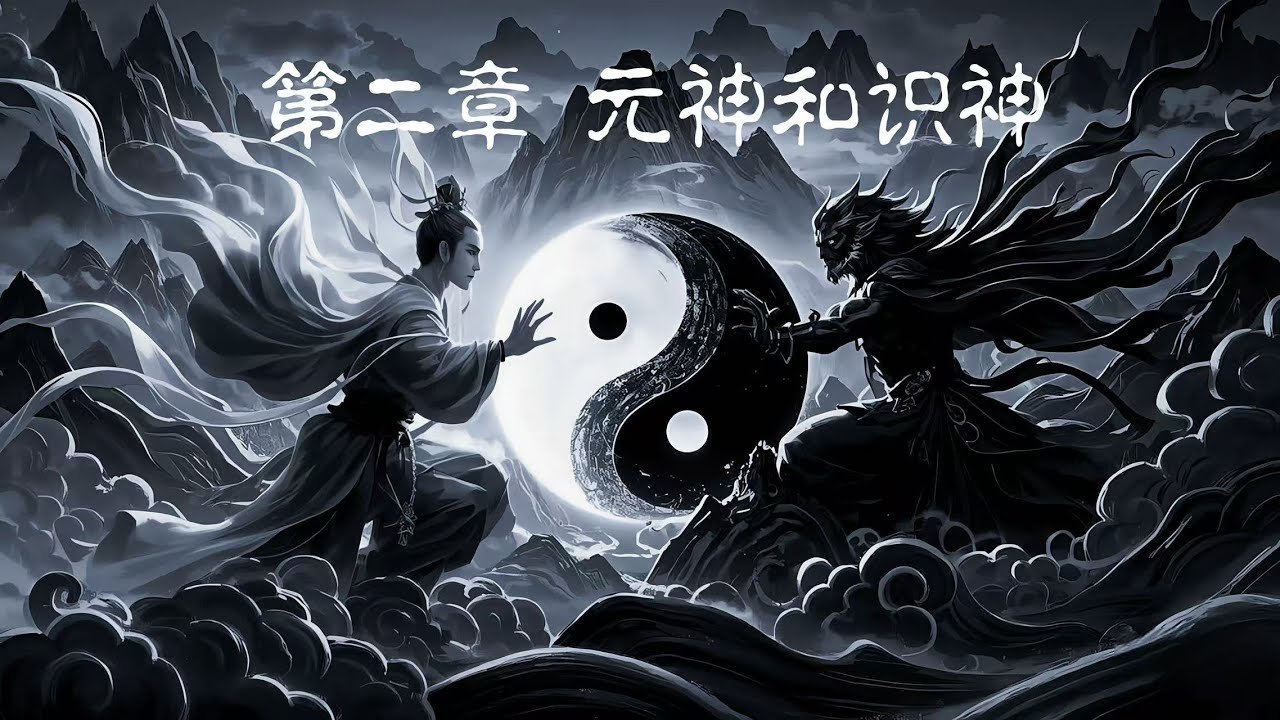
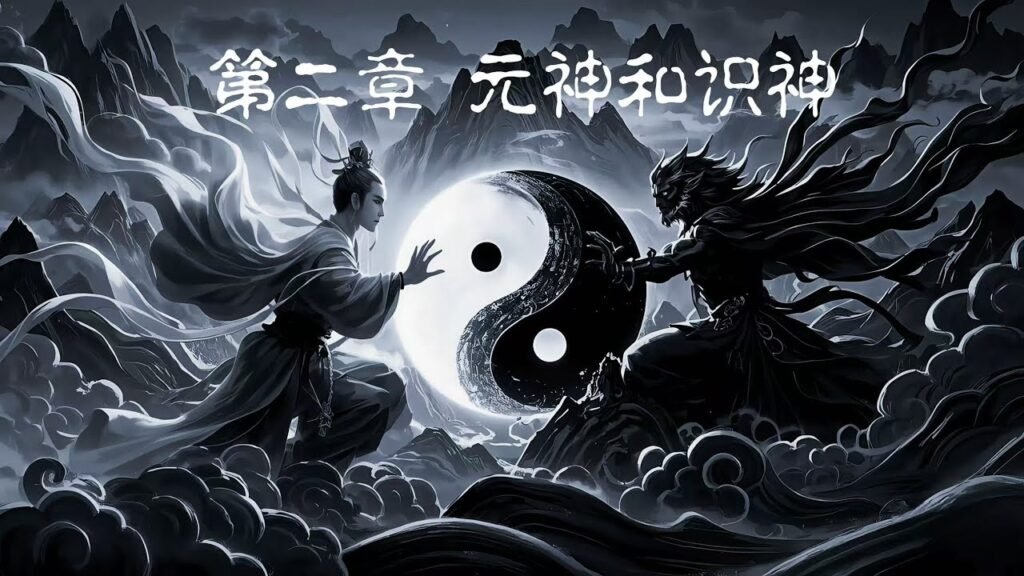
This internal duality is not a unique affliction of modern life. Over a thousand years ago, Lv Dongbin (a legendary Daoist master) fully defined these two forces in The Secret of the Golden Flower as “The Original Spirit” (Yuan Shen)—our innate, primordial awareness—and “The Conscious Spirit” (Shi Shen)—our acquired mind or social ego.
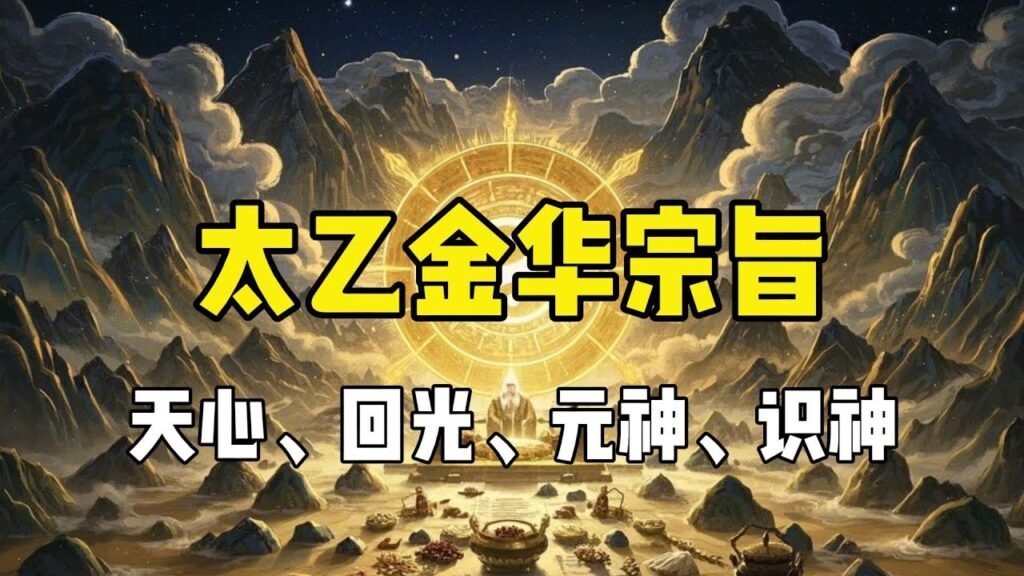
In the early 20th century, the German scholar Richard Wilhelm shared a German translation of this book with the psychological giant Carl Jung, which directly catalyzed the formation of Jung’s theories on the “Collective Unconscious” and the “Self.” Jung once remarked: “This Eastern text on the mind is the core source of all my psychological research” [19]. Similarly, the “Mindful Awareness” at the heart of the MBSR (Mindfulness-Based Stress Reduction) system developed by Jon Kabat-Zinn is fundamentally identical to the Daoist practice of “withdrawing the Conscious Spirit to return to the Original Spirit.”
In today’s AI era, this theory holds even greater practical value: Large Language Models (LLMs) can perfectly replicate the logic, calculation, and memory recall of the Conscious Spirit, but they can never possess the Original Spirit’s innate intuition, non-dual inner peace, or the heartfelt empathy and life-awareness that comes from within. AI has only simulated thinking built from data; it lacks the innate life-essence. This is a unique and irreplaceable advantage of being human.
This article anchors itself in authentic Daoist cultivation texts such as The Secret of the Golden Flower, The Blue Flower Secret Text, and the Yellow Emperor’s Inner Canon. By stripping away obscure jargon and integrating evidence from neuroscience and clinical psychology, we will explore the roots of stress, human suffering, and the core of Daoist practice, catering to both science enthusiasts and long-term practitioners.
I. Returning to the Source: Authentic Daoist Definitions
(1) The Original Spirit (元神 Yuan Shen): Our Innate, Primordial Awareness
Classical Daoist Quotes:
- “The Secret of the Golden Flower“: “The Original Spirit is the true nature… it transcends time and space. Where the Original Spirit exists, there is Wuji (the Infinite), from which Heaven and Earth are born. At conception, the Original Spirit resides in the ‘Square Inch’ (between the eyebrows).” [1]
- Zhang Boduan (Northern Song Dynasty), “The Blue Flower Secret Text“: “The Original Spirit is a spark of spiritual light from the primordial beginning; when the Original Spirit appears, Original Qi is born, and when Original Qi is born, Original Essence is produced.” [2]
- Li Shizhen (Ming Dynasty), “Compendium of Materia Medica“: “The brain is the palace of the Original Spirit.” [3]
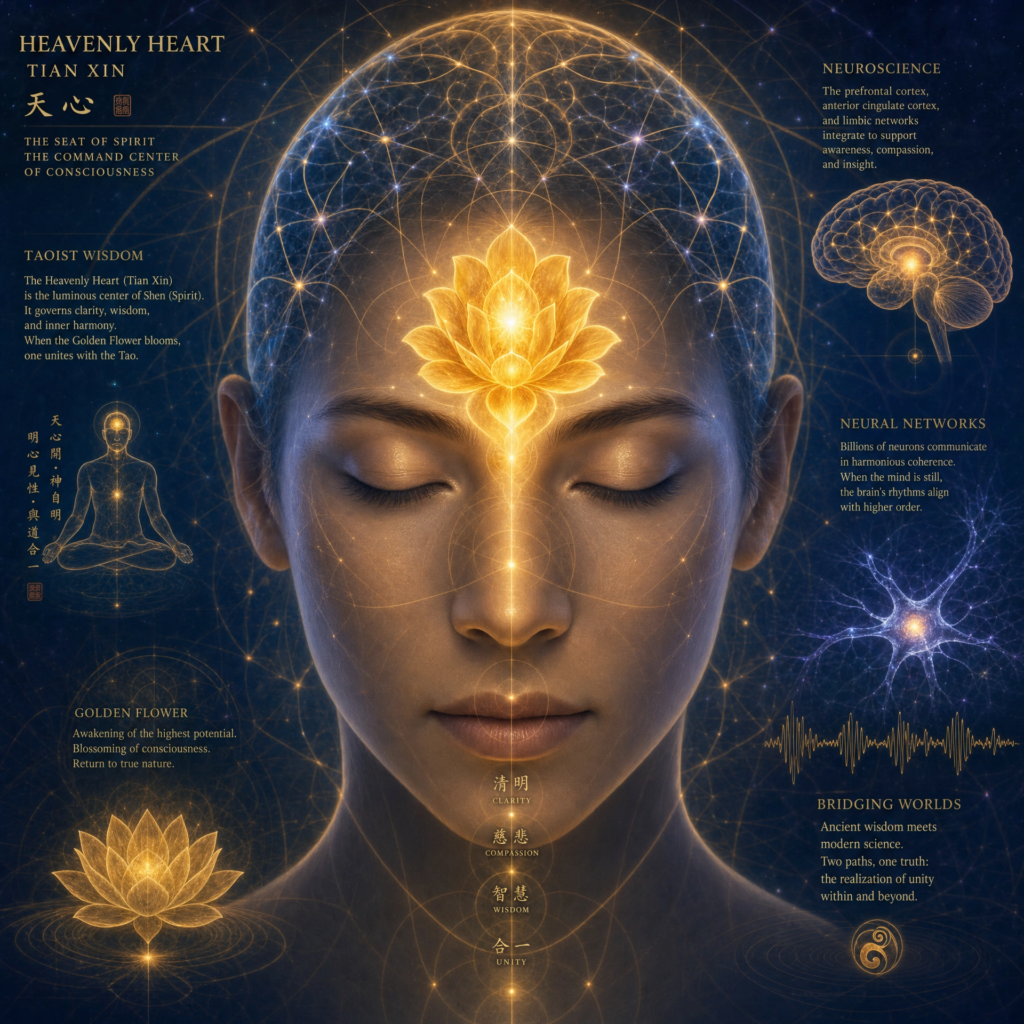
Popular Interpretation: The Original Spirit is the “Innate Wisdom” carried from the primordial source at conception. It resides in the “Heavenly Heart” (Upper Dantian) between the eyebrows. It does not depend on learning, sensory input, or memory. Its core functions include:
- Autonomic Vitality: Heartbeat, breathing, cellular repair, and hormonal balance are all automatically managed by the Original Spirit without needing logical thought.
- Pure Intuition: Bypassing logical deduction to perceive the essence of things directly—what we call “inspiration” or “gut feeling.”
- Cultivating Vitality in Stillness: When the Original Spirit is still, Original Essence and Original Qi naturally regenerate, forming the foundation of self-healing and longevity.
Modern Academic Parallels: Carl Jung’s “Self”; Eckhart Tolle’s “Pure Presence” (from The Power of Now); non-judgmental awareness in mindfulness science; and the activation of the Dorsal Attention Network (DAN) and parasympathetic dominance in brain imaging.
(2) The Conscious Spirit (识神 Shi Shen): Our Acquired Mind or Social Ego
Classical Daoist Quotes:
- “The Secret of the Golden Flower“: “The Conscious Spirit dwells in the lower heart… if one does not eat for a day, the heart feels great unease; it jumps at fear, broods in anger, and is dazzled by beauty.” [1]
- “The Principles of Inner Nature and Destiny“: “The temperament of the acquired nature is the Conscious Spirit.” [4]
- “Lingshu: Ben Shen“: “That which handles things is called the Heart (Mind); that which the Heart remembers is called the Intent; that which is stored in the Intent is called the Will.” All memory, deliberation, and judgment fall under the Conscious Spirit. [5]
Popular Interpretation: The Conscious Spirit is the consciousness carrier formed after birth as the six senses (eyes, ears, nose, tongue, body, mind) receive external information. It is synthesized by brain nerves, acquired memory, emotional desires, and social conditioning.
- Characteristics: It operates through “experience and comparison.” It excels at planning, calculation, and social communication—it is an essential tool for navigating the world.
- Limitations: It is naturally trapped in regrets of the past and anxieties about the future, creating attachments through binary thinking (good vs. bad, gain vs. loss). The Conscious Spirit is dependent on the physical body and vanishes when brain function ceases.
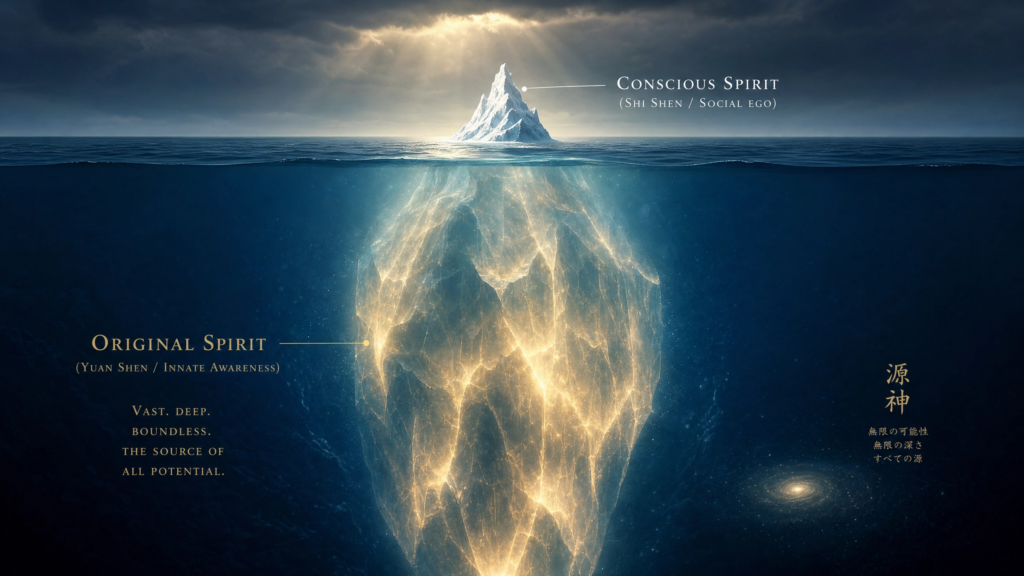
Core Comparison: Original Spirit vs. Conscious Spirit
(Evidence from Classics + Neuroscience)
| Dimension | Original Spirit (Innate Self) | Conscious Spirit (Acquired Ego) | Authority |
| Origin | Primordial Light, innate at birth | Acquired from senses and brain data | The Secret of the Golden Flower[1] r |
| Residence | Between eyebrows (Upper Dantian) | Heart/Brain cortex | Blue Flower [2] |
| Brain Activity | DAN active, DMN quiet, Parasympathetic active | DMN hyperactive, Amygdala alert | Mass General Imaging [14] |
| Thinking Mode | Non-judgmental, pure presence | Past/Future-focused, catastrophizing | Science Study [10] |
| Physiology | Lower cortisol, anti-inflammatory, nourishes Qi | Chronic high cortisol, depletes energy, causes insomnia | Meta-analysis [8] |
| Survival | Eternal, independent of body | Dependent on brain, dies with body | Inner Nature [4] |
| AI Replication | Impossible (No innate intuition/experience) | Fully replicable (Logic, memory, deduction) | AI Psychology [11] |
East-West Convergence:
- Jung’s “Secret of the Golden Flower”: The Original Spirit corresponds to the deep “Self” of the collective unconscious, while the Conscious Spirit corresponds to the surface “Ego.” Healing is the return to the Original Spirit [19].
- Eckhart Tolle’s “The Power of Now”: Egoic mind = Conscious Spirit; Eternal Presence = Original Spirit. Most suffering comes from identifying with the acquired mind [25].
II. The Daoist Hierarchy of Life: Sovereignty and Service
According to texts like Seven Slips of a Cloudy Satchel, The Secret of the Golden Flower etc. we can map the energy chain of life in Daoist world:
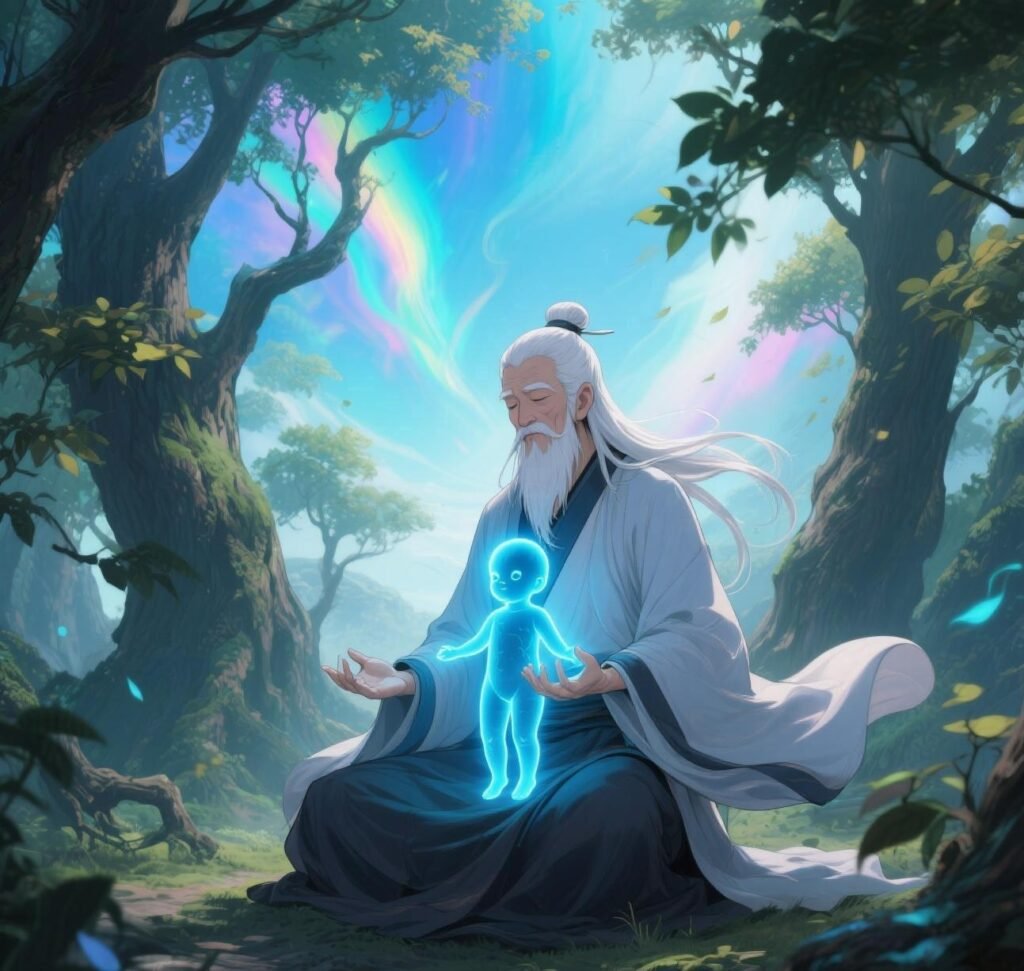
- Top Level: the Original Spirit — The Sole Sovereign. The source of Essence, Energy, and Spirit (Jing-Qi-Shen). Like a monarch, it provides energy for the souls, spirits, and the Conscious Spirit.
- Middle Level: The Three Souls魂 (The Bridge from Yuan-shen to body).
- Tai Guang: Direct projection of the Original Spirit (Conscience/Intuition).
- Shuang Ling: Source of the Conscious Spirit (Logic/Thought).
- You Jing: Source of desires and habits, bodily lusts.
- Bottom Level: The Seven Po 魄 & The Conscious Spirit (Execution). The “Po”魄 attach to the physical organs and carry instincts. The Conscious Spirit is the “Steward” or manager handling external affairs.
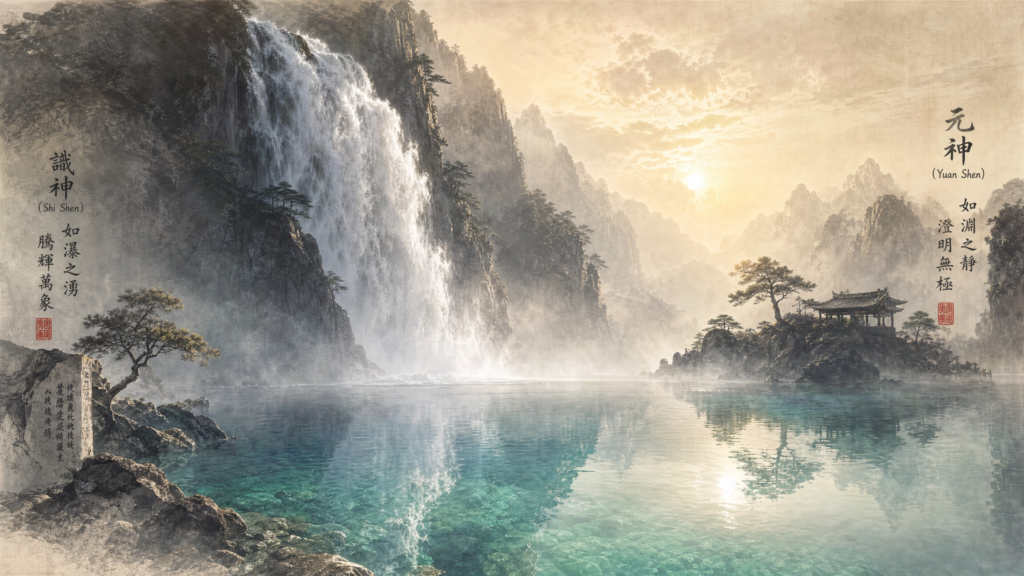
The Waterfall Analogy: The Secret of the Golden Flower compares the Conscious Spirit to a turbulent waterfall and the Original Spirit to the deep, still pool beneath. Practice is not about “killing” the water (stopping thought), but about guiding the flow so the Original Spirit sits as the Sovereign and the Conscious Spirit acts as the loyal Steward.
III. The Root of Suffering, Stress, and Aging
Application 1: Burnout is a “Coup” by the Conscious Spirit
- Daoist View: The Tao Te Ching says, “Five colors blind the eye.” The Conscious Spirit always grasps outward. Anxiety and self-doubt are merely “catastrophic narratives” woven by the Steward.
- Neuroscience: A 2010 Science study found we spend 47% of our time in mind-wandering (DMN hyperactivity), which correlates with lower happiness and higher anxiety [10]. This “mental noise” consumes more energy than focused work, leading to high cortisol, hair loss, and immune decay.
- Stress Management: Reducing stress isn’t about removing external troubles, but about cutting off the Steward’s rumination and returning awareness to the Original Spirit.
Application 2: Aging is “Spirit Scattering”
- The “Forward Flow”: Society and media strengthen the Conscious Spirit’s comparison-mind. The Steward usurps the Sovereign, leading to a constant leakage of vital energy (Jing-Qi-Shen).
- The “Reverse Flow” (Daoist Cultivation):
- Refining Essence into Qi: Quieting desires to guard the vital essence.
- Refining Qi into Spirit: Using stillness to weaken the Steward’s dominance.
- Refining Spirit into Emptiness: Dissolving the ego’s binary view to experience unity.
- Science of Aging: Chronic DMN activation accelerates telomere shortening and systemic inflammation. Guarding the Original Spirit stabilizes the endocrine system and delays aging.
Application 3: Avoiding the Pitfalls of Practice
The Golden Flower warns against three main errors:
- Don’t force thoughts to stop. Forcing the mind to be blank causes neurological disorders and hallucinations.
- Don’t chase visions. Lights or deities seen in meditation are often just neural discharges or creations of the Conscious Spirit (DMN).
- The Core Method: “Turning the Light Around” (Hui Guang). Gently withdraw your outward-projecting attention and rest it in the “Heavenly Heart.”
IV. Survival in the AI Age: Our Final Moat
AI can handle all “Steward” tasks (writing, calculating, evaluating), but it cannot touch or gain the Original Spirit:
- No Innate Intuition: AI uses probability; the Original Spirit uses direct insight [7].
- No True Life Experience: AI simulates peace and joy; it does not feel them.
- No Presence: AI is always calculating past data or future scenarios; it cannot dwell in the “Now.”
The Insight: The future belongs to those who can silence the Steward and awaken the Original Spirit’s creativity, which is non-replaceable.
V. Practical Tools: Returning to the Original Spirit
How can we effectively reassign the Conscious Spirit’s role, and return the power to the Original Spirit? Following are a few simple exercises to start.
(1) 3-Minute “Emergency Reset”
- The 5-4-3-2-1 Technique: Identify 5 objects, 4 textures, 3 sounds, 2 smells, and 1 taste. This forcefully interrupts the DMN and pulls you back to the Original Spirit’s presence.
- Simple “Light Turning”: Close your eyes slightly. Rest your attention between your eyebrows. Note: “Thoughts are the Steward; Stillness is my home.”
- The “Heel Breath”: Inhale for 4s, hold for 2s, exhale for 6s. Imagine the breath sinking to your heels to activate the parasympathetic system.
(2) Daily 10-Minute Foundation
- Posture: Sit upright, tongue to the roof of the mouth.
- Focus: Gently rest awareness on the “Heavenly Heart.” If thoughts drift, gently bring them back without self-judgment.
- Scientific Result: 8 weeks of 10-minute mindfulness thickens the hippocampus (emotional regulation) and shrinks the amygdala (stress center) [14].
(3) Daily Practices for Nourishing the Original Spirit
Aligned with the three stages of Taoist refinement and cultivation
- Draw the six senses inward. Reduce fragmented stimulation from short-form videos and avoid pointless interpersonal gossip and conflict. In this way, we stop continually feeding the Conscious Spirit with distracting information.
- Leave five minutes of open space each day. Step away from cellphone or E-devices and simply sit quietly, allowing the mind to rest without trying to accomplish anything. This gives the Original Spirit the space it needs to restore the body’s qi and blood—the vital and circulatory resources of life in traditional Chinese medicine.
- Cultivate an altruistic intention. Loosen the Conscious Spirit’s self-centered habits of comparison, competition, and attachment. As these habits recede, the natural compassion arising from our shared origin in the Original Spirit can emerge on its own.
(4) Self-Test: The Three Stages of Returning the Original Spirit
- Breaking the Ice: Conscious Spirit still dominates; frequent burnout and dreaming. Focus: Early sleep and emotional release.
- The Tug-of-War: Original Spirit gains strength; intuition increases; logic and emotion begin to balance. Focus: Daily stillness.
- Stable Sovereignty: External praise or blame no longer disturbs the heart. The Steward is merely a tool. Energy is consistently full.

VI. Common Misconceptions
- ❌ “Practice the original spirit means stopping all thought.” Correction: The waterfall analogy shows thoughts are natural; we only need to establish the correct hierarchy (Sovereign vs. Steward).
- ❌ “Seeing lights means I’ve reached the Original Spirit.” Correction: All forms are illusions; lights are often just neural activity. The Original Spirit is formless, pure awareness.
- ❌ “Cultivating the Original Spirit means eliminating the Conscious Spirit.” Correction: The Conscious Spirit is indispensable for language, planning, learning, and daily responsibilities. Practice restores the proper relationship: the Original Spirit leads; the Conscious Spirit serves.
- ❌ “Every intuition comes from the Original Spirit.” Correction: Fear, desire, habit, and unconscious bias can also feel intuitive. Genuine inner knowing is usually quiet, clear, non-compulsive, and not driven by self-interest. It should still be tested against facts, ethics, and consequences.
- ❌ “Returning to the Original Spirit means becoming passive.” Correction: Inner stillness is not withdrawal from life. It allows action to become more appropriate, economical, and compassionate—less reactive, but often more effective.
- ❌ “The Original Spirit is a special trance or extraordinary mystical experience.” Correction: Unusual sensations, lights, visions, or bliss may occur, but they are not reliable evidence of realization. The more meaningful signs are greater clarity, stability, compassion, humility, and freedom from compulsive reactions.
- ❌ “I can simply pay for a ceremony to awaken my Original Spirit.” Correction: It is already within you. You only need to quiet the Steward to feel it.
Conclusion
From Lv Dongbin to Carl Jung, to mindfulness movement, and to modern neuroscience, all wisdom points to one truth: You are not your thoughts. Most anxiety, stress and accelerated aging stem from the Steward usurping the Sovereign’s throne.
The Original Spirit is your birthright, carrying the power of healing and longevity. You don’t need to move to a cave; you only need to practice awareness in your daily life. Let the Sovereign lead, and let the Steward serve.
This battle for sovereignty is not about killing the mind, but about restoring order. Today, put down your phone and sit in silence for 5 minutes. In that stillness, you are already reclaiming your throne. Believe it—you are the “God” you have been waiting for.
(Ready to begin your journey to Daoist longevity? Join our weekly Qigong classes and the “Daoist Secrets of Longevity” community to explore the mysteries of mind and body with practitioners worldwide. https://daosecrets.net/qigong/ )

References
I. Classical Chinese Texts
[1] Lu Dongbin. The Secret of the Golden Flower. 《太乙金华宗旨》
[2] Zhang Boduan.The Blue Flower Secret Text. 《玉清金笥青华秘文》
[3] Li Shizhen.Compendium of Materia Medica. 《本草纲目》
[4] Min Yide.The Principles of Inner Nature and Destiny. 《性命圭旨》
[5] Yellow Emperor’s Inner Canon: Lingshu. 《黄帝内经・灵枢》
[6] Clear and Tranquility Classic 《清静经》
[7] Zhang Junfang. Seven Slips of a Cloudy Satchel. 《云笈七签》
II. Western Science Literature
[8] Zhou H X, et al. Rumination and the default mode network: Meta-analysis of brain imaging studies[J]. Neuroimage, 2019, 202: 116187.
[9] Gao W, et al. Ventromedial prefrontal cortex mediates rumination and depression. Cerebral Cortex, 2022.
[10] Killingsworth M A, Gilbert D T. A Wandering Mind Is an Unhappy Mind[J]. Science, 2010, 330(6006): 932.
[11] Liu W. Artificial intelligence lacks subjective self-awareness. Science.cn, 2024.
[14] Lazar S W, Kerr C, Wasserman R H, et al. Mindfulness meditation training changes brain structure in 8-week intervention participants[J]. Psychiatry Research: Neuroimaging, 2011, 191(1): 36-43.
[19] Jung C G. The Secret of the Golden Flower[M]. Princeton: Princeton University Press, 1968.
[23] Kabat-Zinn J. Full Catastrophe Living: Using the Wisdom of Your Body and Mind to Face Stress, Pain, and Illness[M]. Bantam Books, 2013.
[25] Tolle E. The Power of Now[M]. Penguin Books, 1997.
[26] Maher C, et al. Meditation-induced neuromodulation of amygdala and hippocampus[J]. PNAS, 2025, 122(30): e2409423122.
[27] Chou T, et al. The default mode network and rumination in individuals at clinical depression risk [J]. Social Cognitive and Affective Neuroscience, 2023, 18 (1).